

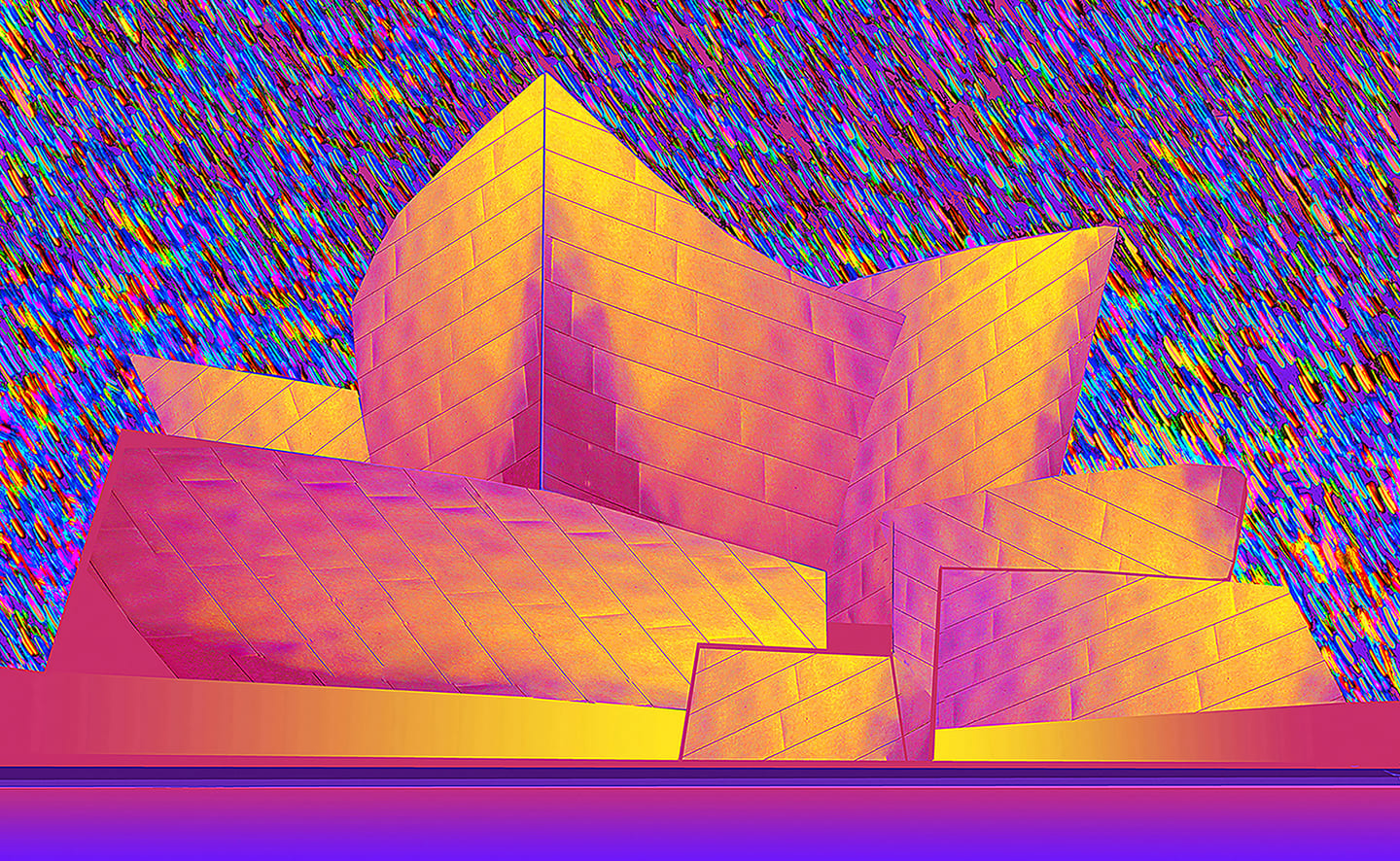
Photography criticism tends to reserve its highest praise for restraint: the decisive moment, the unmanipulated frame, the photographer as witness rather than author. Jane Gottlieb’s work asks critics to set that framework aside. Hers is a photography of intervention, in which the camera captures only the first draft of an image that will later be reworked, recolored, and reimagined. To understand her practice is to understand photography not as a record of the world but as raw material for one.
A Relationship With Color That Precedes the Subject
Most photographers develop a signature through subject matter. Gottlieb’s signature precedes subject matter; it lives in her relationship with color itself. Across more than thirty years of work, she has approached color less as a descriptive property of the world and more as an expressive tool in its own right, something to be amplified, exaggerated, or reorganized depending on what an image needs. Light functions similarly in her photographs. It is not simply captured but courted, treated as an active collaborator rather than a fixed condition to be worked around.

This orientation explains why Gottlieb has been drawn, throughout her career, to subjects that other photographers might consider too plain to warrant attention. Her ability to locate visual richness in ordinary surroundings is not a matter of finding unusually photogenic scenes. It is a matter of applying an unusually active visual imagination to scenes that would otherwise pass unremarked.
From Photograph to Composition
What separates Gottlieb from a straightforward color photographer is her willingness to continue working after the image has been captured. She has spoken of using Photoshop to paint, combine, and enhance her photographs, a process that treats the original image as a starting point rather than a finished statement. This is a meaningfully different proposition than digital retouching in the conventional sense. Gottlieb is not correcting imperfections. She is extending an image’s possibilities, layering color and composition until the photograph begins to resemble a painted construction as much as a captured one.
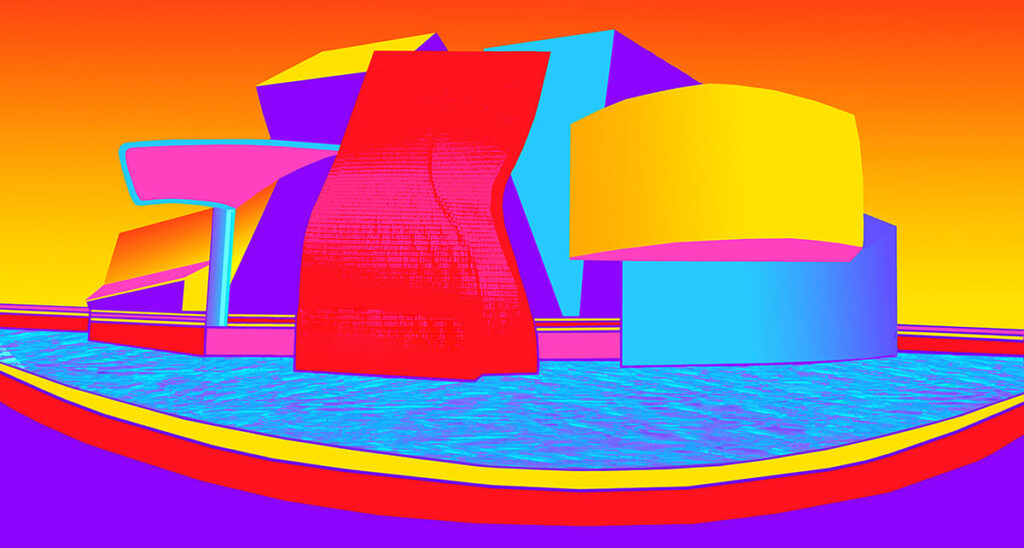
Critics are sometimes wary of this kind of post-production intervention, worried it might undercut photography’s claim to authenticity. But Gottlieb’s work suggests a more interesting proposition: that the manipulation itself is where her artistic voice lives. The photograph is the occasion for the work, not the entirety of it.
Gehry’s Buildings as Photographic Subject
This approach finds its fullest expression in Gottlieb’s photographs of Frank Gehry’s architecture. The relationship between the two goes back many years, to a period when Gottlieb photographed for Gehry directly. She has remained an admirer of his work ever since, and her sustained engagement with his buildings, particularly his structures in Bilbao and Los Angeles, forms one of the more coherent bodies of work in her career.
Gehry’s architecture is, on its own terms, already an argument against convention: curved steel, improbable angles, surfaces that seem to resist a single stable reading depending on the light and the viewer’s position. For a photographer interested in transformation rather than documentation, this makes for unusually generous material. Gottlieb does not merely record these buildings from a flattering angle. She extends their logic, using her camera and subsequent digital work to push their forms further into abstraction, further into color, further away from architectural photography’s usual documentary function.
The result is a body of work that treats architecture as a starting point for artistic interpretation rather than a subject to be faithfully reproduced. In Gottlieb’s photographs, a Gehry building is not simply captured; it is reimagined, run through the same process of color amplification and imaginative recombination she applies elsewhere in her practice.
Documentation Versus Interpretation
The distinction matters critically. Architectural photography, as a genre, has long been oriented toward clarity: showing a structure’s form, its materials, its relationship to its site. Gottlieb’s photographs of Gehry’s work pursue something closer to interpretation, using the building as a departure point for an image that ultimately says as much about her own artistic sensibility as it does about the architecture itself.
This is not a small distinction. It repositions the photographer from witness to co-author, a role that Gottlieb appears entirely comfortable inhabiting. Her images of Bilbao and Los Angeles do not ask to be evaluated as accurate representations. They ask to be evaluated as artistic statements that happen to use architecture as their subject.
A Practice Still Expanding
What makes Gottlieb’s body of work compelling from a critical standpoint is its refusal to settle into a fixed method. Her use of Photoshop, her colorful imagination, and her long-standing fascination with Gehry’s structures all point toward an artist still actively expanding what photography can be asked to do. Three decades into her career, she remains less interested in perfecting a single technique than in continuing to test how far an image can travel from its original capture before it becomes something entirely her own.
Experience how photography meets paint and digital transformation in her celebrated Frank Gehry series. View the prints at janegottlieb.com.