

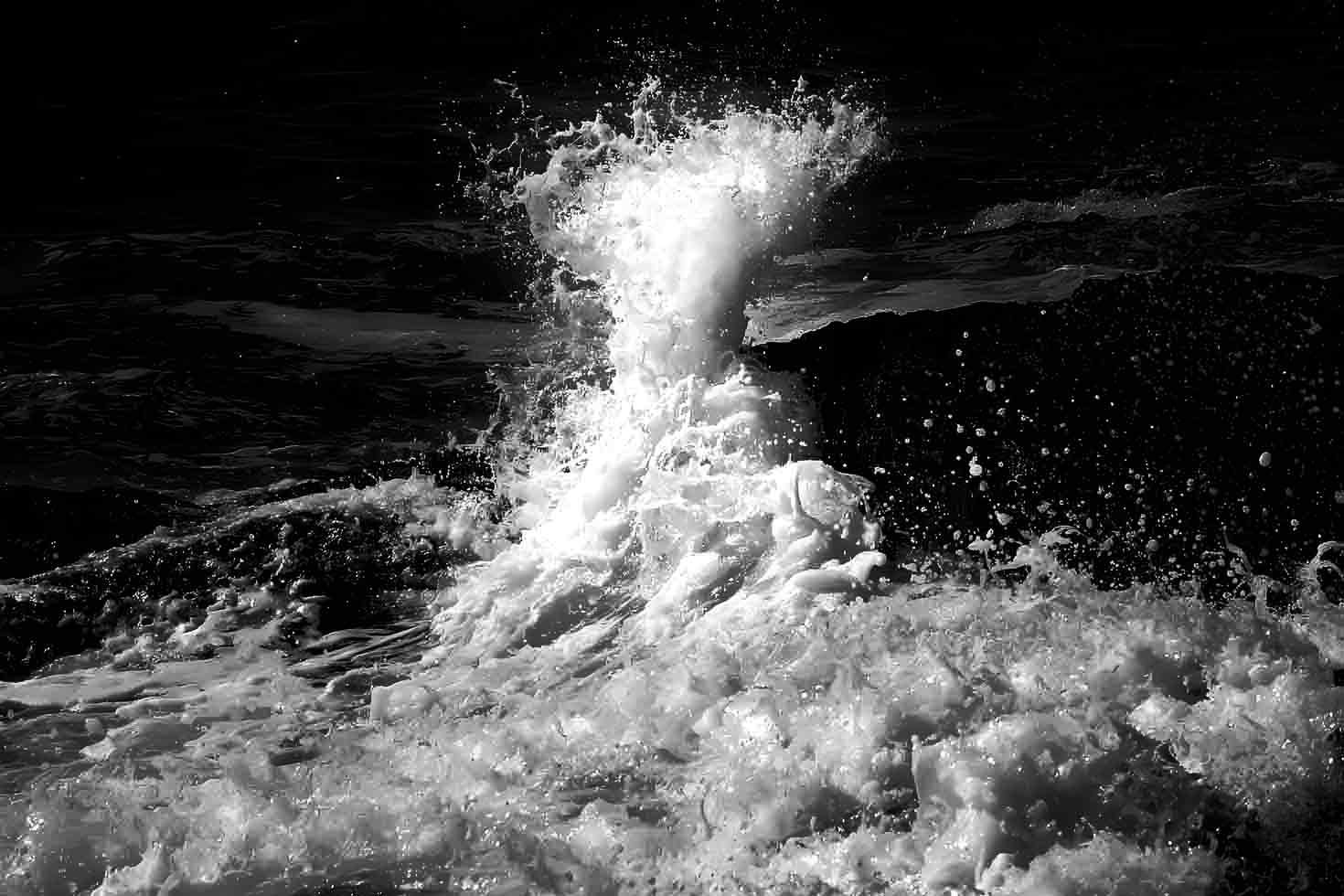
The wave has already begun to fall apart by the time you notice it. That is the first sensation of Tidal Force Unleashed, Karel Fehr’s black and white photograph of surf striking rock: a column of white water thrown upward, its crest breaking into spray, the stone beneath it dark and unmoved. The moment is violent and, strangely, perfectly still.
The Instant Before the Collapse
According to the official description, a fast shutter speed freezes the action, and the image bears that out. Individual droplets hang apart from the main mass, each one sharp enough to catch its own highlight. The foam at the base of the wave shows its grain. Nothing is smeared into a veil of motion the way a longer exposure would soften it.
That choice is worth dwelling on, because water photography offers a fork. Slow the shutter and the sea turns to mist, a calm cloud that denies its own force. Speed it up and the sea becomes anatomy: you see how a wave is built, how it breaks, how much of it is air. Fehr takes the second path, and the picture reads like a diagram of impact drawn in light.
There is a pleasing paradox in this. We experience waves as continuous, a rhythm of arrival and retreat. A fast exposure breaks that rhythm into a single frame that no eye could ever catch, and the result is a version of the sea that feels more truthful than direct observation, because it shows what speed hides.
Detail also dictates scale. The larger droplets, rendered as crisp spheres, tell us how violently the water has been thrown, while the finest spray at the margins dissolves into a haze of points, almost like a star field. The viewer can measure the event by these gradations, from heavy clots of water to specks too small to count.
Two Tones and a Diagonal
Colour is absent, so structure carries the image. The deep blacks of the rock and the surrounding water press against the bright whites of the spray, and the composition tilts along diagonals. The rising wave leans one way, the scattered droplets trail another, and the eye is pulled across the frame in a sweeping arc, never settling long enough to feel safe.
Black and white also changes what the water is. In colour, a wave belongs to a place, with a particular sea and a particular hour. In monochrome it belongs to physics. Without hue, attention goes to texture, from the glassy smoothness at the wave’s shoulder to the ragged lace of foam below. The official text argues that removing colour sharpens the drama, a familiar claim in photography, and here it holds, because the subject is already a conflict between two materials, one yielding and one not.
Notice, too, how much information lives in the mid-greys. The picture is not simply black against white. The foam passes through dozens of tones as it thins toward the edges of the spray, and those gradations are what give the explosion its volume. Strip them out and the wave would flatten into a graphic shape.
A Timing Problem Solved in Advance
Anyone who has tried to photograph breaking surf knows how little control there is. Waves do not repeat, and the best frame arrives and vanishes within a fraction of a second. What looks like luck is often preparation: reading the swell, choosing a vantage, anticipating where the water will strike, and committing to a burst of exposures.
The artist’s website does not describe how this particular frame was made, so that remains conjecture. What the picture does show is the habits of a photographer comfortable deciding at speed, with a clean exposure, a held highlight and detail kept in both the brightest and darkest areas. Fehr’s commercial career ran for more than four decades, and precision is part of that job, so the discipline carries over cleanly.
Water in a Larger Body of Work
The gallery text describes Fehr’s first collection as nature abstracted, built mainly from floral and water subjects seen through macro vision. Tidal Force Unleashed is the loudest member of that family. Where most of the collection leans toward the intimate and the slow, this image is public, kinetic and elemental. It also stands apart in being monochrome within a collection otherwise dominated by colour.
Yet it shares the family’s central interest, which is transformation by attention. A petal enlarged becomes a landscape; a wave frozen becomes a sculpture of spray. In both cases the photograph captures a condition that exists only briefly and gives it the permanence of an object.
That permanence is the real subject. The wave is gone within a second of the shutter’s release, but the picture keeps it at the point of maximum drama, mid-explosion and unresolved. A fleeting event has been turned into a lasting statement, and the statement is as plain as the picture is complex: the sea does not need an audience to be magnificent, but a good photograph can supply one.
See the wider gallery, from water to petals, at karelfehr.com.