

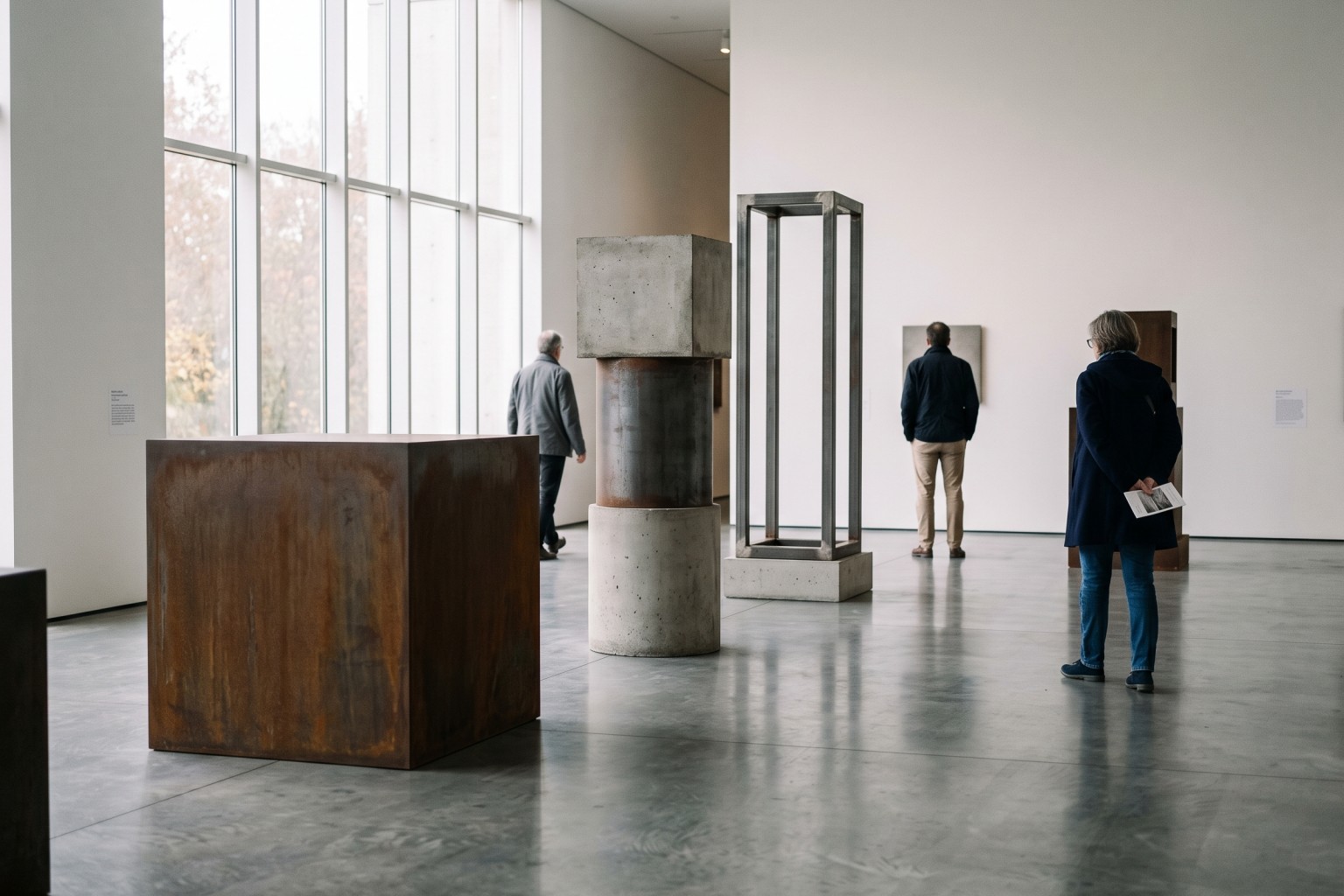
The 1960s witnessed a profound shift in the art world, as a new movement emerged that sought to redefine the very essence of art: Minimalism. This radical departure from the emotional intensity and gestural freedom of Abstract Expressionism championed an aesthetic of purity, focusing on fundamental forms, raw materials, and the relationship between the artwork and its surrounding space. Minimalist sculptors, including seminal figures like Donald Judd and Carl Andre, embarked on a quest to distill art to its absolute core, often employing industrial materials and straightforward constructions.
Donald Judd, a pivotal voice in the movement, famously articulated the concept of the “specific object,” a term he used to describe works that defied easy categorization as either traditional painting or sculpture. His creations frequently took the form of stacked boxes, often made from steel, aluminum, or plywood, arranged in precise, repetitive progressions. These wall-mounted or freestanding units emphasized the inherent qualities of the materials and the mathematical precision of their arrangement. Judd’s work rejected any illusionistic qualities or symbolic meanings, insisting instead on a direct, unmediated encounter with the object itself – a “what you see is what you see” philosophy that became a hallmark of Minimalism.
Carl Andre further pushed the boundaries of sculptural practice with his innovative floor pieces. Rejecting the conventional pedestal, Andre arranged identical units of industrial materials, such as metal plates (copper, steel, zinc) or bricks, directly on the gallery floor. These arrangements transformed the viewing experience, inviting the observer to walk upon or around the artwork, thus becoming an active participant in its physical presence and its interaction with the architectural environment. Andre’s sculptures underscored the importance of horizontal expanse and the literal ground upon which art exists, challenging centuries-old traditions of vertical, elevated sculpture.
Beyond Judd and Andre, other artists contributed significantly to the minimalist sculptural vocabulary. Dan Flavin, for instance, utilized commercially available fluorescent light fixtures to create site-specific installations, exploring the interplay of light, color, and space. Like his contemporaries, Flavin’s work focused on the literal properties of his chosen medium, transforming mundane industrial objects into luminous artistic statements that altered perceptions of architectural space.
A core tenet of Minimalism was the rejection of narrative, illusionism, and overt symbolism. Minimalist artists were not interested in telling stories or creating representations; their focus was squarely on the object’s inherent qualities, its materiality, and its direct engagement with the viewer’s experience. The artwork existed as an autonomous entity, its meaning derived from its physical presence, its scale, and its interaction with the surrounding environment, rather than from external references or emotional content.
The emphasis on industrial materials was a deliberate choice, signaling a move away from the handcrafted and the unique towards the manufactured and the reproducible. Steel, aluminum, concrete, and industrial lighting were favored for their neutrality, their durability, and their ability to convey a sense of objective presence. This choice of materials underscored the movement’s commitment to stripping away superfluous elements, presenting art in its most unadorned and essential form.
Minimalism profoundly impacted subsequent art movements and reshaped the discourse around art’s purpose and presentation. By demanding a direct, unmediated encounter with the art object and its literal qualities, it challenged viewers to consider their own relationship to the artwork and the space it occupied. The movement’s austere beauty and rigorous intellectual framework continue to resonate, reminding us of the power found in simplicity, clarity, and the unvarnished truth of form and material.