

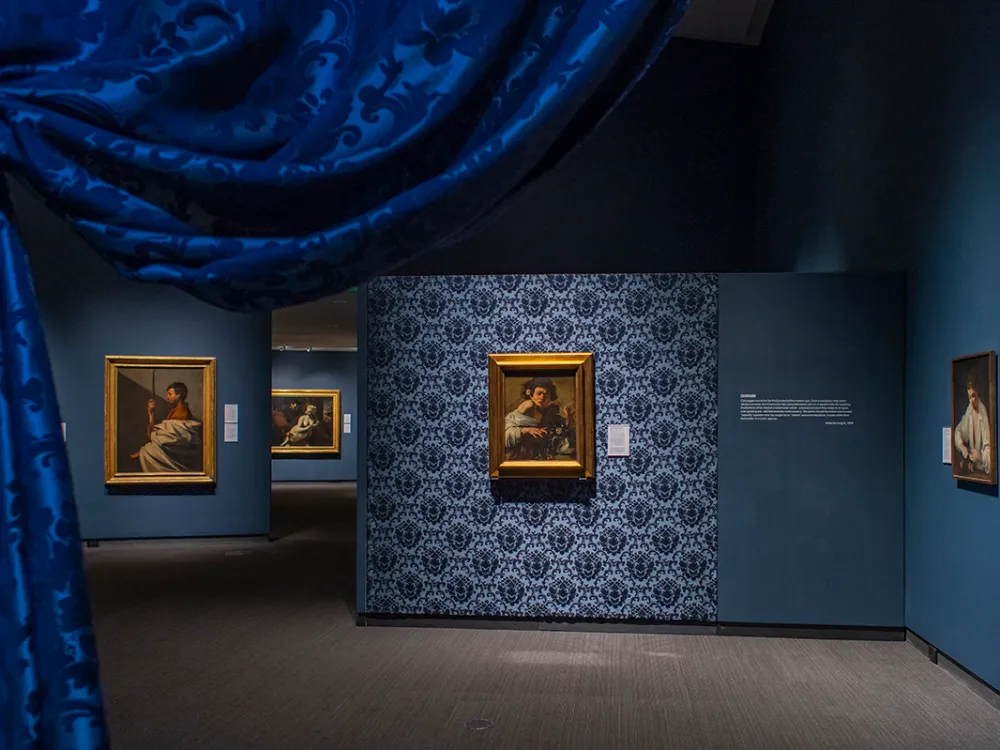
Stanton Thomas, curator of the exhibition “In Caravaggio’s Light: Baroque Masterpieces from the Fondazione Roberto Longhi” likens laying eyes on Boy Bitten by a Lizard, the centerpiece of this show, to listening to original recordings on vinyl. Not only is the painting along with 39 others by Caravaggio and an international cast of Caravaggisti, as the Baroque artist’s followers are known making a rare trip from Florence to the U.S., it is presented unconserved, in its original state. “Maybe the varnish is a little yellow, or there are a few scratches,” Thomas explains. “But you are seeing the brilliance of the artist’s hand, which is unsullied and untouched.
“In Caravaggio’s Light” is on view at the Museum of Fine Arts, St. Petersburg, through Mar. 22, 2026, at which point it will travel to the Mint Museum in Charlotte, N.C.. All of the 40 paintings are from the collection of Roberto Longhi, the Italian art historian known for revitalizing Caravaggio’s reputation as a groundbreaking artist whose flair for the dramatic steered painting into the Baroque period.
Below, Thomas highlights five of the paintings from the Longhi Foundation that he was most keen to bring to the U.S. for the exhibition.
Caravaggio: Boy Bitten by a Lizard, ca. 1597

Seeing this painting arrive at the museum and go on the wall was very emotional for me. There’s something so profound about this work. It’s pretty clearly associated with homoeroticism, and a degree of luxury and decadence that most people didn’t have access to. But nonetheless it’s a very typical looking human being with a very typical reaction. It’s not about anything, really, except for emotion and a reaction to physical pain. I think it must have just electrified people, because it set off this whole wave of the beginning of the Baroque.
Jusepe de Ribera: St. Bartholomew, ca. 1612

For as much as the Caravaggio is modern Longhi said that Caravaggio is the first modern painter—I have to say that Ribera is shockingly contemporary. This is such a strange, terrifying image. One of the reasons I love the Baroque so much is that it mirrors our own time: there’s violence and excitement and drama and, at the same time, it’s grounded in the human experience. This painting has an honestly and a brutality about it that gets me every time. St. Bartholomew is holding his skin in one hand and a knife in the other. It’s almost like he’s extending the knife out to you, which is a very Baroque conceit: this idea that somehow or another we’re culpable and involved in his pain.
Matthias Stom: Annunciation of Samson’s Birth, ca. 1630-32

Matthias Stom is not very well known in the U.S. He was probably Flemish, maybe Northern Netherlandish, and he traveled to Rome and became a part of the ex patriate community of Northerners there. I find his paintings particularly powerful because his palette is so rich and vibrant. A lot of times, Caravaggio and the Caravaggisti used a more autumnal palette, with more subdued colors. But the Northerners used goldens and reds and blues, which really heighten the subject matter.
I particularly love the expressions on the faces of the parents of Samson. These people have been waiting for years for a child. And then Gabriel comes into the room in this lovely burst of light, and you have these shocked, awestruck reactions.
Valentin de Boulogne: Denial of St. Peter, ca. 1615-17

I’d always wanted to see this painting in person. It’s absolutely titanic. The figures are life-size. It’s hung three or four feet off the ground, so you’re staring up at it, like an altar. You’re seeing the tableau unfold and you become part of the group of people that is accusing Peter and watching him fumble.
It’s such a profound picture, with all these amazing psychological reactions. You have the soldiers who are fighting over Christ’s clothes by rolling the dice for them. But what always gets me is the accusation the woman on the far right makes of St. Peter, who is just this old, tired, dejected man. His leader has been executed and he forgets his faith for a while. To make this clear, Valentin de Boulogne not only shows this on St. Peter’s face, but he shows him reaching down towards some coals as if he’s trying to warm his hands, which is the iconography for trying to rekindle your faith.
Carlo Saraceni: Judith with the Head of Holofernes, ca. 1610-20

Because of the way it’s painted with these unbelievable passages of smoky shadows, this painting doesn’t reproduce very well. Pulling it out of the crate, I was like, ah this is what it’s about. It was a tour de force on the artist’s part to evoke this very dark space where you have this sense of triumph in the figure. The story kind of evolves and blooms while you’re standing there looking at it. A lot of people have asked, did that painting move?